
Supercross 101
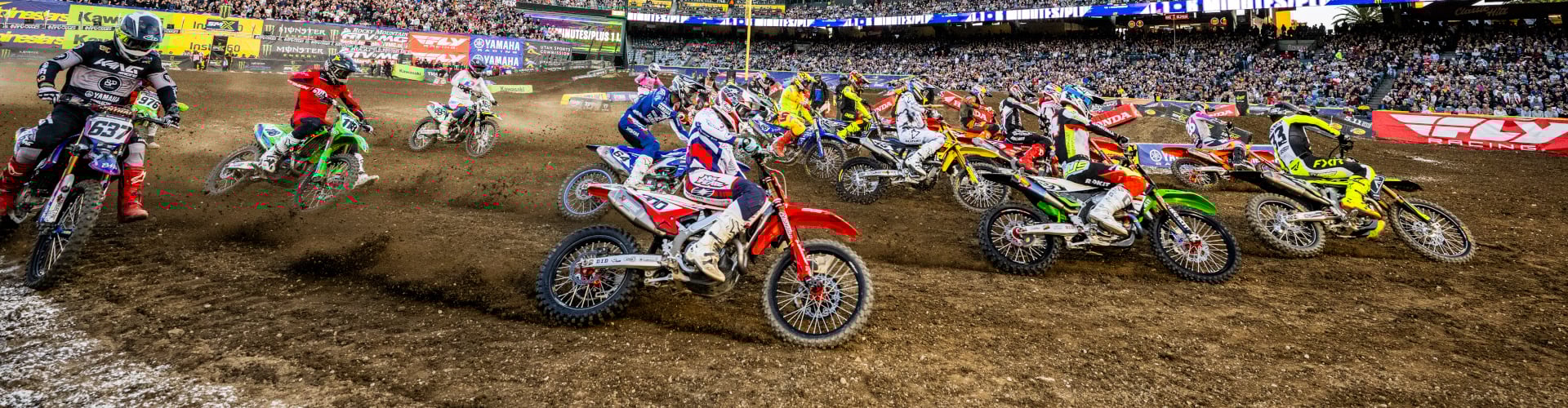
Monster Energy Supercross is an indoor dirt bike racing championship – a newer version of motocross, the sport’s original form. Whereas motocross takes place on long courses built primarily on the dirt and terrain offered up by nature, Supercross races are made from dirt hauled into stadiums. Monster Energy Supercross is held from January through May in open stadiums (in cities with nicer weather) and covered domes. The track takes all the exciting obstacles of outdoor riding—jumps, turns, and bumps—amplifies them, and puts them in easy view of spectators.
The Classes
There are two divisions racing: the 450 Class and the 250 Class. Top riders like Jett Lawrence, Chase Sexton, Cooper Webb, Jason Anderson, Ken Roczen, and Eli Tomac are in the premier 450 Class, and they ride 450cc four-stroke motorcycles.
The 250 Class is populated primarily by younger riders on 250cc four-stroke motorcycles. The class is split into East and West Regions, each of which crowns its own champion.
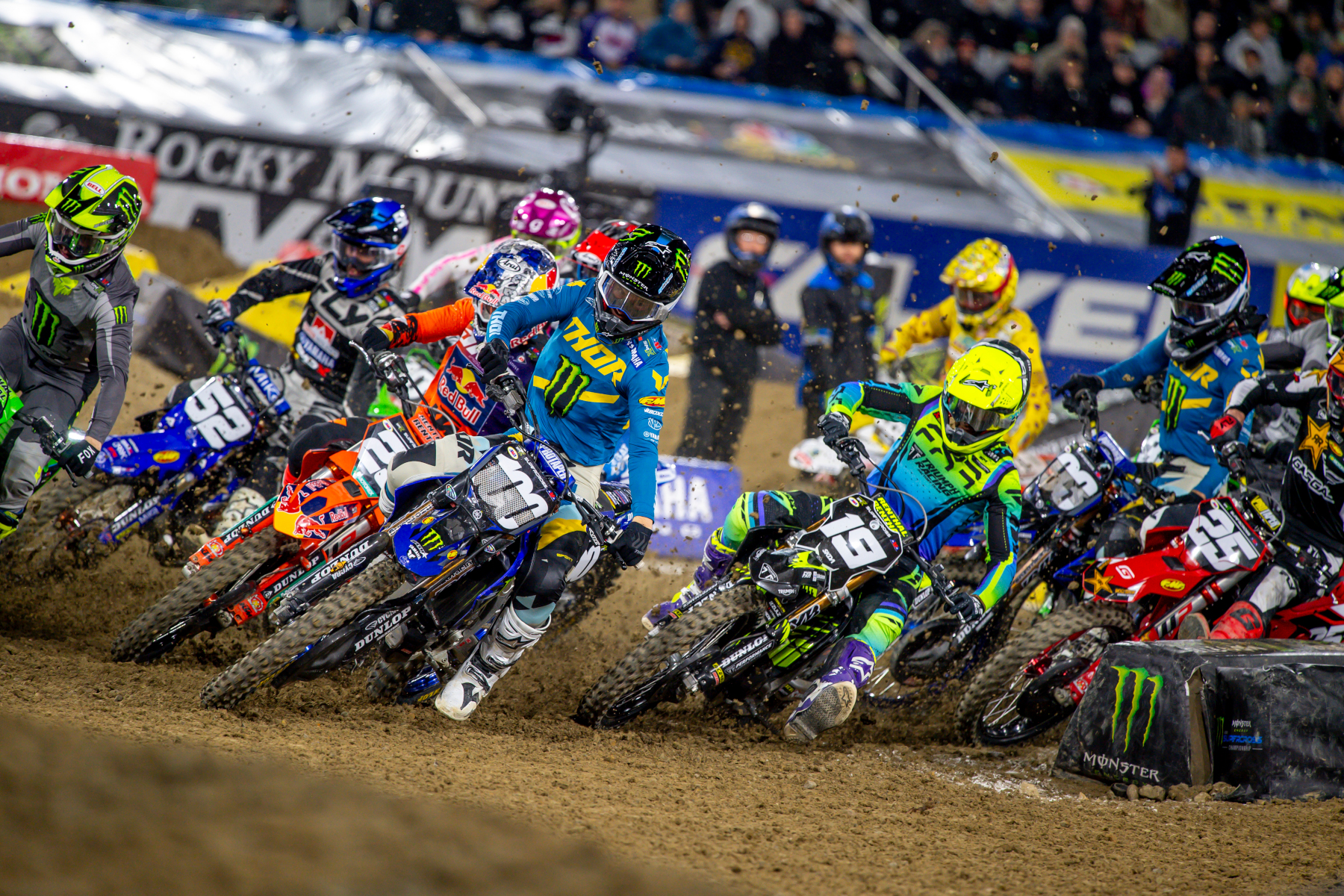
Ten different manufacturers currently create 250cc and/or 450cc bikes in Monster Energy Supercross:
- Beta
- Ducati
- GasGas
- Honda
- Husqvarna
- Kawasaki
- KTM
- Suzuki
- Triumph
- Yamaha
These motorcycles are highly modified versions of what you can purchase at your local dealership. The transmissions feature four or five gears, and the shift lever is by the left footpeg. The rear-brake lever is by the right footpeg, the clutch lever on the left side of the handlebar, and the throttle and front brake on the right side of the handlebar. Bikes can be any color, but teams generally stick with the same colors as the stock machines. Most bikes are four-strokes of either 250cc or 450cc displacement. A Supercross bike can generate nearly 70 horsepower and weighs around 220 pounds, giving it a better power-to-weight ratio than a top-level NASCAR vehicle.
The numbers 250 and 450 refer to the engine size, as measured in cubic centimeters of displacement (cylinder bore x piston stroke). The 450s boast more power and torque than the small machines, but they’re also more difficult to control and weigh a bit more. The 250s tend to rev higher, while the 450s sound a little more “grunty.” The actual lap times between the two bikes are similar, but in a head-to-head race, a 450 can out-jump a 250 and make passes by accelerating harder out of turns– that’s why the fastest riders use the bigger bikes.
The Track
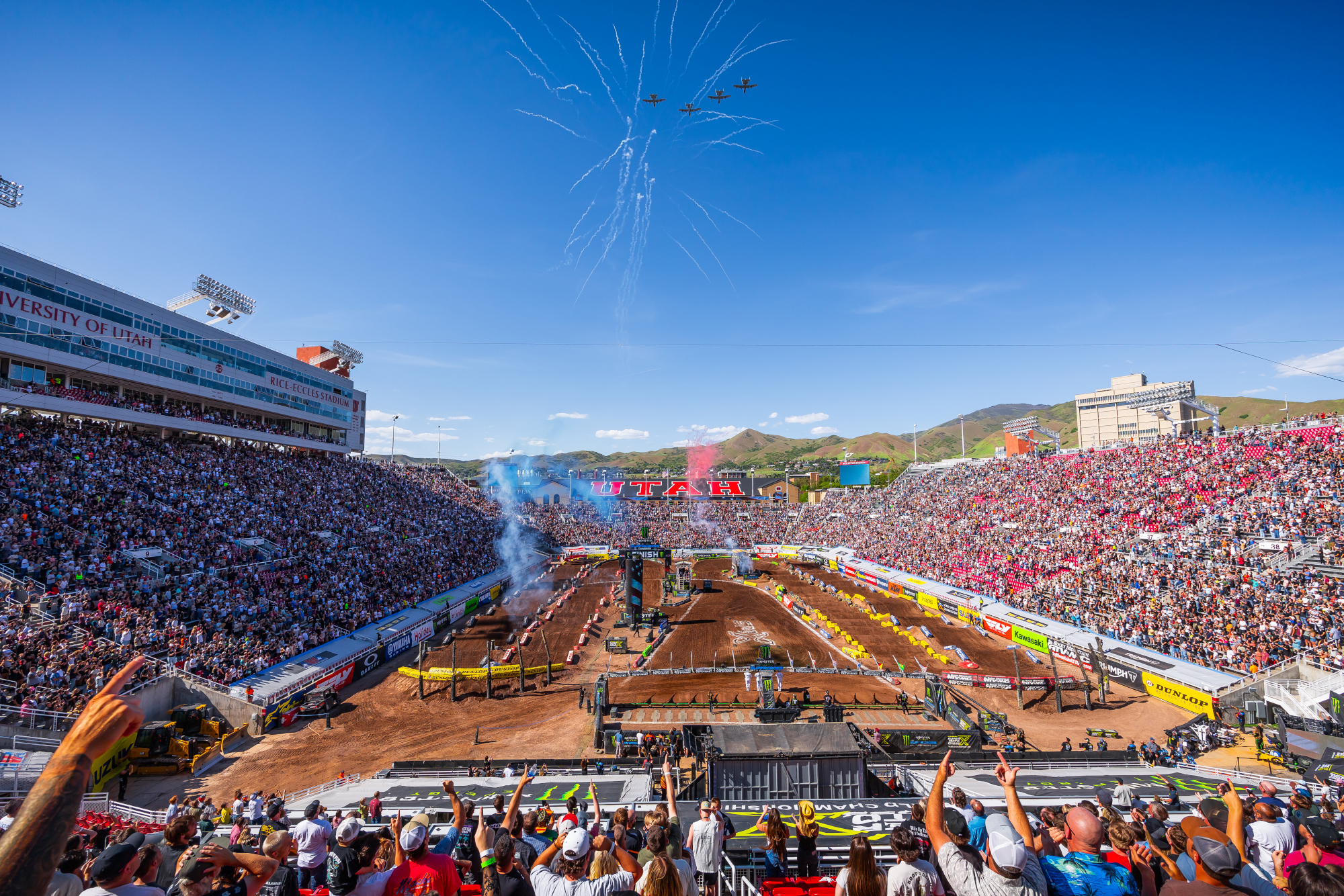
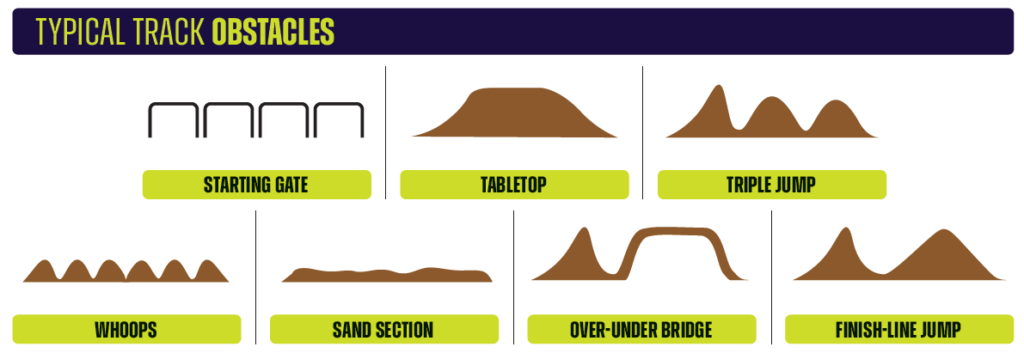
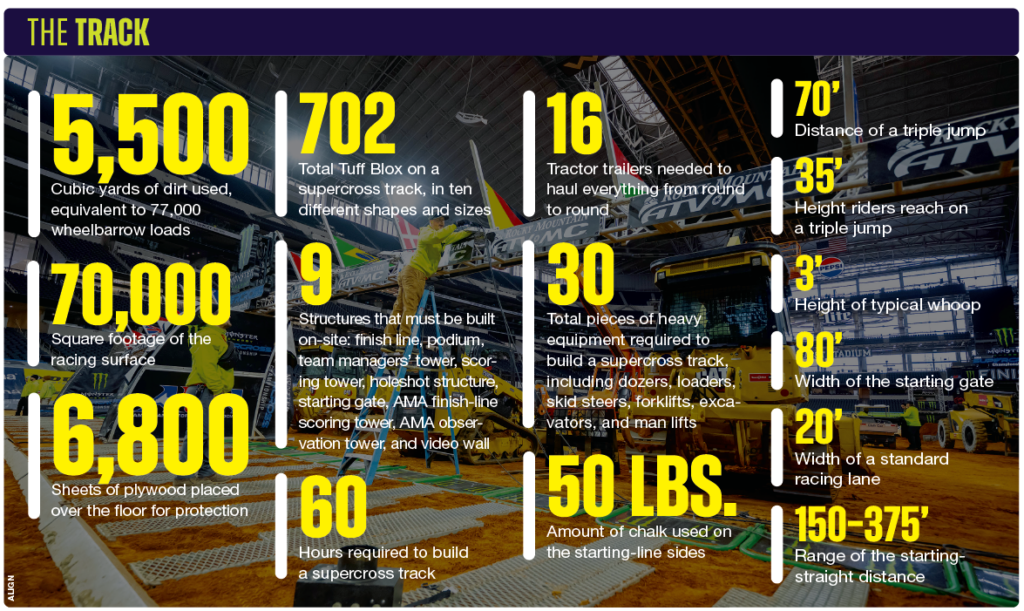
A Supercross track represents the ultimate evolution of the sport. Among the many obstacles riders must negotiate every lap are whoop sections (brutal washboards where riders skim along the tops of the bumps), rhythm sections (irregular series of jumps with a variety of combination options), and triple jumps (three jumps in a row that riders normally clear in a single leap of 70 feet or more). Many of the turns have banked berms, but some are flat.
It takes roughly five hundred truckloads of dirt to make up a Supercross track. Soil conditions can be hard-packed, soft, muddy, sandy, rutted, or any combination thereof. Average riders would find it impossible to even do a lap on a Supercross track, let alone race at high speeds.
Race Format
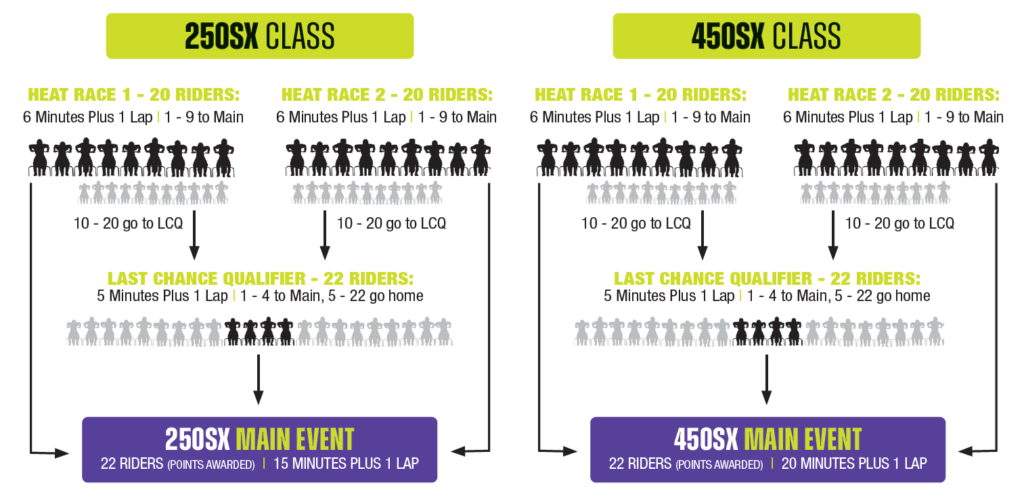
Since Monster Energy Supercross is one of the most prestigious forms of motorcycle racing on earth, it should come as no surprise that there are always more riders itching to race than there are available spots on the starting line. So how do you whittle down the field? The first eliminations happen during the morning and afternoon, where riders take part in two timed practice sessions. During the timed sessions, each racer’s lap times are recorded using electronic transponders. When practice ends, the riders with the fastest lap times (40 each in 250SX and 450SX) advance to the night program.
A supercross gate only has room for 22 riders, so the fast 40 from qualifying must compete in a series of Heat Races and a Last Chance Qualifier (LCQ) to determine who gets to line up for the Main Event. Each class (250SX and 450SX) has two 20-rider Heat Races, with the top nine finishers from each Heat transferring to the Main Event. Heat Races last for six minutes plus one lap. When the Heats are complete, the remaining riders compete in the LCQ, which lasts for five minutes plus one lap. With only four riders from each class making the final cut, the LCQ usually features some of the roughest and most exciting racing of the night.
Triple Crown Format
Aside from the standard format, there are three special Triple Crown Races which will allow fans to see their favorite riders race even more than on a typical night of Monster Energy Supercross. Instead of just one Main Event, Triple Crown rounds will feature three Main Events in both 250SX and 450SX. The three 250SX Main Events are all ten minutes plus one lap. In 450SX action, the Main Events are twelve minutes plus one lap. To determine an overall winner, an Olympic scoring system will be used: first place is awarded a single point for that race, second gets two points, and so on. The rider with the fewest points at the end of the night wins; second-fewest takes second, etc. Championship points are then awarded based on the overall finish. Click here to learn more.
East/West Showdown
Prior to 2022, the East/West Showdown was held at just the season finale. It’s always been considered one of the most exciting parts of Monster Energy Supercross, and nowadays there are three instances where the 250SX East and West regions tangle. The East/West Showdown pits East and West 250SX riders (who usually don’t compete together) against each other. It’s a rare chance for fans to settle arguments about which region has the fastest riders. Race and scoring formats are the same as all the other races. Click here to learn more
The Lingo of Supercross
- AMA: American Motorcyclist Association
- CC: Cubic centimeters (in reference to engine displacement)
- Displacement: The space covered or volume swept out by the engine piston at each stroke
- Disqualification: Unless otherwise specified, the forfeiture of all points, awards, and prizes earned during a particular race
- Flaggers: Workers stationed at various points around the track to advise riders of track conditions via color-coded flags
- Get-off: A crash
- Heat Race: A qualifying race determining which riders advance to the main event
- High-side: A crash where the rider goes over the top of the bike, as opposed to laying it down (or a “low-side”)
- Holeshot: Taking the lead into the first turn of a race
- Homologation: The process of acquiring eligibility for a motorcycle to be entered in competition, with rules formulated to create parity among race bikes and maintain a level playing field for competitors
- LCQ: Last Chance Qualifier race, where four top finishers advance to the Main Event.
- Line: A specific way around the track or through a particular part of the track; can vary with changing course conditions
- Main Event: The races in 250SX and 450SX to determine the overall results
- OEM: Short for original equipment manufacturer
- Overall: The final ranking of an event
- Pit/paddock: Area primarily designated for the preparation and maintenance of race equipment, it may also include parking for transporters and other support vehicles
- Pit crew: Mechanics and/or team assistants
- Privateer: A racer competing without the benefit of a factory contract or major sponsor support
- Program: The predetermined outline of events that make up a race day
- Qualify: To advance to the next step of the race program by time trial or finishing position in a heat race
- Seize: Engine failure due to excessive heat buildup
- Stoppie: Riding on the front wheel only, usually under hard braking
- Wheelie: Riding on the rear wheel only, usually under hard acceleration
- Works: Refers to parts being tested in competition by a manufacturer
- Wrench: Slang for mechanic
Supercross FanFest
Monster Energy Supercross FanFest puts fans inside the action before the gate drops, offering an up-close look at the teams as they prepare, practice, and qualify for race day. It’s where the day begins and the intensity starts to build.
Fans can watch timed qualifying before the Heat Races, get close to the bikes, and catch incredible photo opportunities throughout the paddock. FanFest also features sponsor activations, interactive displays, free Monster Energy drink sampling in select markets, food trucks and vendor areas, and of course official supercross merchandise for purchase. Along the way, fans may even get the chance to meet their favorite riders and enjoy exclusive entertainment.
It’s an essential part of the supercross experience and the best way to soak in everything that happens before the lights turn on and the racing begins.
The Points
Finishing positions in the main events of both 450SX and 250SX have the following point structures:
- 1st Place: 25 points
- 2nd Place: 22 points
- 3rd place: 20 points
- 4th place: 18 points
- 5th place: 17 points
- 6th place: 16 points
- 7th place: 15 points
- 8th place: 14 points
- 9th place: 13 points
- 10th place: 12 points
- 11th place: 11 points
- 12th place: 10 points
- 13th place: 9 points
- 14th place: 8 points
- 15th place: 7 points
- 16th place: 6 points
- 17th place: 5 points
- 18th place: 4 points
- 19th place: 3 points
- 20th place: 2 points
- 21st place: 1 point
- 22nd place: 0 points
The Start
The most important part of any race is the very beginning. Starting up front is key to finishing there, as even a 20-minute + 1 lap Main Event rarely provides enough time to pass 20-some riders. Racers begin by lining up against a gate that guarantees everyone leaves at the same time. They choose their positions in the Heat Race based on practice times and in the Main Event on qualifier performance. In Supercross, riders generally prefer the straightest line possible to the first turn, usually toward the middle of the gate.
Once riders are lined up, a 30-second card is displayed, indicating that the gate will drop in about that much time. Five to ten seconds before the gate drops, the card is turned sideways. The gate drops backward and will trap anyone who attempts to jump the start. The first rider to cross the chalk line in the first turn—by utilizing quick reflexes, throttle control, power, and good traction—has earned the holeshot.
Signals
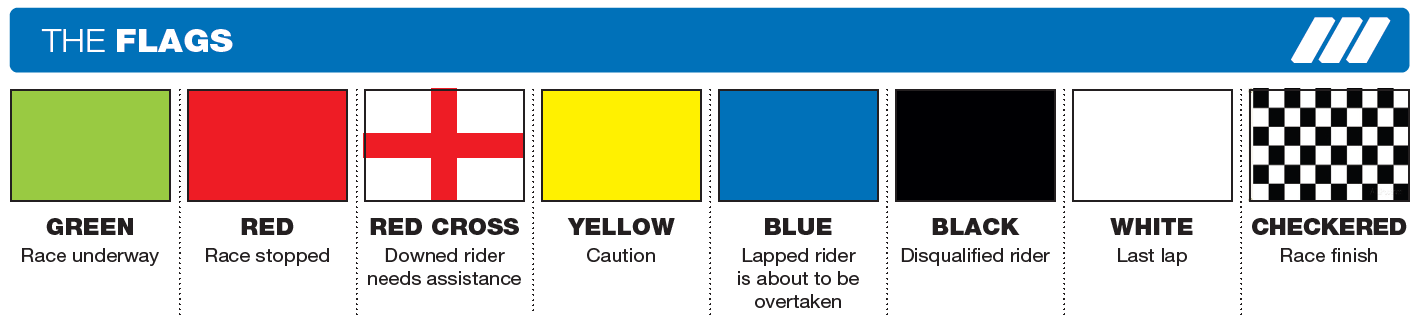
Riders are not allowed to wear radios in their helmets, so they get information in other ways—specifically, via color-coded flags. Yellow (with accompanying yellow flashing lights) warns that another rider in down or stalled ahead; blue informs a rider he’s about to be lapped; crossed white and green flags at the finish tell riders the race is at the halfway mark; white indicates one lap remaining. Of course, the checkers come out for the finish.
Teams communicate with their athletes by writing messages on dry erase boards and holding them out as their riders pass. These pit boards can only be displayed in the designated mechanic’s area.
Rarely, a red flag will be displayed, indicating a premature end to the race. A red flashing light at the beginning of a triple jump means a rider is down and racers should roll the jumps and not attempt passes.
The Skills
The riders may be on high-powered dirt bikes, but the engine certainly doesn’t do all the work. Riders must guide heavy machines around brutal tracks at high speeds, and you’ll notice they’re rarely even sitting down, instead using their arms, legs, and core to manipulate it in the desired direction. Races are unbelievably demanding in terms of cardiovascular fitness, stamina, strength, coordination, and concentration, and the consequences of mistakes are higher than in most sports. Scientific tests suggest that Supercross is one of the most physically demanding sports in the world, and those who do it at this level are professional athletes with demanding training regimens and strict diets. Road bicycling, running, weight training, and swimming—as well as riding every day, of course—are some of the popular ways riders prepare their bodies.
Rider Support
Most of the riders you see are backed by sponsors—some more so than others. Factory squads are run directly by the manufacturer of the team’s bikes, with riders earning lucrative salaries, riding meticulously prepared equipment, and being supported by technicians, engine suspension specialists, test riders and mechanics, PR workers, truck drivers, and so on. Factory riders often use their own salary to employ trainers, agents, and practice mechanics.
Satellite teams receive support from a manufacturer but are run privately; budgets vary widely among these outfits. Riders who pay their own way to the races are called privateers, and although many still have equipment sponsors to help ease the financial load, they’re still the working-class heroes of Supercross racing.
Rider Numbers
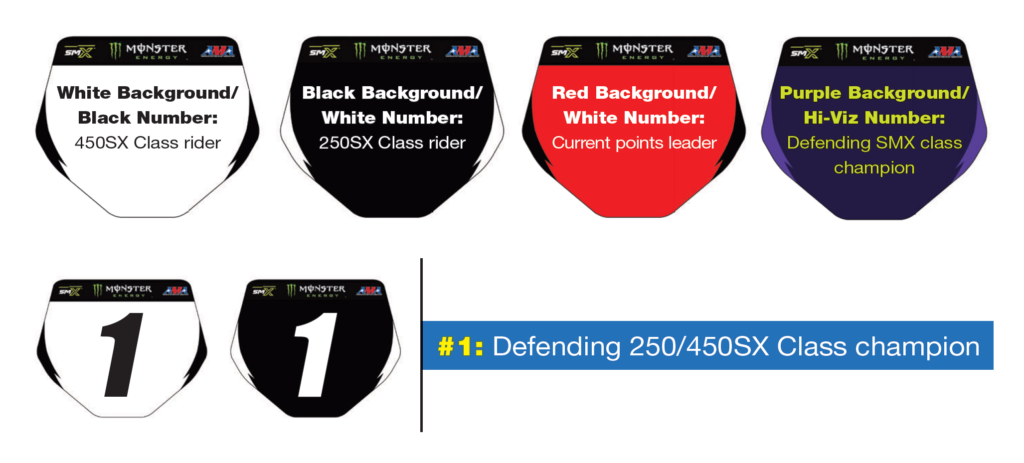
The best way to identify any Supercross rider is by his rider number, which is acquired in a few different ways. Riders who have won national Supercross or motocross championships earn the right to single-digit career numbers, although they can also choose a two-digit career number. Riders who finished in the top ten overall in a combined Supercross/motocross season earn the right to claim permanent numbers as well. Beyond those, riders earn up to number 99 though total points accumulated during the previous Monster Energy Supercross and Lucas Oil Pro Motocross season. Riders who don’t earn a number from 1 to 100, including rookies, can choose numbers between 101 and 999.
Number Plates
Champions
Every round of Monster Energy Supercross is extremely important, because every Main Event pays points toward the championship. The higher you finish, the more points you earn (25 for first, 22 for second, 20 for third, and so on). Wins are obviously important since they award the most points, but so is consistency and avoiding injury. The 450 Class riders compete for points at all 17 rounds, starting with Round 1 in Anaheim and ending with Round 17. Two championships are awarded in the 250 Class—one for the Eastern Region and one for the Western Region; these riders compete in eight races each to crown a champion.